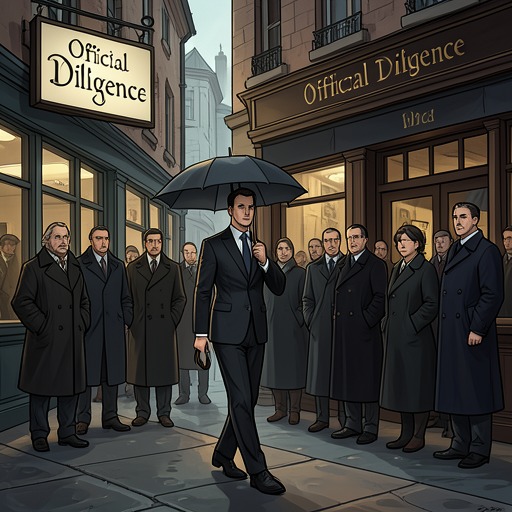
Bureaucratic corruption
Dead SoulsBureaucratic corruption in Dead Souls is not merely a collection of dishonest officials but a self-renewing system of private extraction hidden inside public procedure. Chichikov learns to turn the machinery of office to his advantage, while the provincial officials’ panic over his business exposes their own vulnerability. Even when reform appears to arrive, corruption changes its methods and resumes under a more respectable appearance. Gogol’s satire thus makes official disorder both comic in its evasions and serious in its consequences.
Official Procedure and Public Anxiety
The provincial officials cannot agree on what Chichikov’s purchase of dead souls signifies. Some dismiss the abduction story circulating about him, while others insist that the transactions must conceal something contrary to order and discipline. Their unease intensifies when a new Governor-General is appointed: they anticipate transfers, reprimands, and official dinners, and fear that reports already circulating in town will attract unwelcome scrutiny. The phrase “dead folk” even prompts the Director of the Medical Department to wonder whether the matter might refer to patients who died in local hospitals after inadequate preventive measures. His speculation turns the officials’ vague anxiety into a more concrete fear of responsibility.
Two documents then deepen the uncertainty. One warns that a forger of rouble notes, using different aliases, is active in the province; the other instructs the local Governor to arrest any suspicious newcomer unable to produce references or passports. The officials do not know Chichikov’s identity, and their attempts to gather information from his servants yield little: Petrushka offers no useful account, while Selifan says only that his master worked in government service and customs. Their final debate therefore turns on an unnerving reversal: whether Chichikov is a person they ought to arrest, or someone who might be able to detain them for their own lack of respectability. The machinery of official suspicion is active, but its operators are too implicated and confused to use it with confidence.
Chichikov’s Methods in Office
In his early government career, Chichikov advances through charm, diligence, and calculated delay. When a petitioner reaches for letters of recommendation to have signed, Chichikov stops him and insists that carrying out official duties is an obligation, not a service requiring reward. He promises that the papers will be delivered to the petitioner’s home. They do not arrive the next day, or the day after, and the petitioner eventually discovers that the business has not even been entered. Only then does the petitioner learn that money must be provided for the copyists.
The supposed fee is itself an instrument of deception. The petitioner is told that each copyist must receive a rouble, although each will get only a quarter-rouble and the remainder is said to go to the Government. The arrangement lets Chichikov present himself as a man of integrity while transferring the burden of illicit payment onto an apparently impersonal office routine. The suitor, frustrated by delays and new charges, curses the clerks and the officials who claim to be disinterested. The episode makes corruption difficult to locate: the public face is scrupulous, the transaction is concealed in paperwork, and responsibility is displaced down the chain of office.
Chichikov’s appointment to a commission supervising a government building gives this method a larger stage. For six years the building fails to rise above its basement, with climate or defective materials offered as explanations. Meanwhile, handsome private houses appear for commission members elsewhere in town, and the officials prosper. Chichikov, who had previously maintained a strict personal austerity, begins to enjoy the fruits of this prosperity: he hires a good cook, buys distinctive clothing and fine horses, and acquires expensive soaps. The contrast between the stalled public building and the members’ private advancement turns a failed construction project into a visible measure of misappropriated public purpose.
Reform and Its Reversal
The arrival of a new military Director briefly disrupts the arrangement. He demands accounts, uncovers deficits and missing sums, and directs attention to the officials’ houses. Officials are retired in large numbers, while houses are confiscated for government use or converted into institutions and schools for soldiers’ children. Chichikov is among those whose position collapses. The Director’s crackdown is real enough to threaten the existing circle, but it does not establish a durable culture of accountability.
The replacement officials soon learn how to manage the Director. They maintain a discreet exterior and humour him until he grows mild; believing himself to have chosen honest subordinates, he is in fact surrounded by more effective thieves than before. Their office turns into an agency for detecting irregularities, and the pursuit of irregularities itself becomes a source of income: those conducting the investigations accumulate thousands of roubles. Some members of the former group return to service after professing rectitude, whereas Chichikov cannot regain his position. The episode’s central reversal is that reform does not abolish corruption; it supplies a new vocabulary and procedure through which it can be concealed and profited from.
Customs and the Smuggling Conspiracy
After losing his earlier position, Chichikov eventually enters the Customs Department, a post he had long coveted for the elegant goods its officials could obtain. He masters its procedures with extraordinary speed. He can assess goods from invoices, weigh and measure them, and search suspected travellers with unrelenting attention, including their clothing and vehicles. His diligence initially makes smuggling difficult and earns the notice of his superiors. He proposes a plan for detecting contraband and receives the authority to conduct searches and investigations without limit.
That authority is precisely what Chichikov needs. A smuggling association has already organized a scheme promising profits of millions, and its agents had previously tried to enlist him. He had refused while he lacked influence; once he held the power to control searches, he signalled that the time had come. He brings in a vulnerable fellow official, and the arrangement proceeds. In the account of the scheme, Spanish sheep cross the frontier carrying valuable Brabant lace between layers of fleece. Chichikov’s position as head of Customs makes the operation possible, and after three or four such crossings he and his accomplice have acquired four hundred thousand roubles each; some accounts put Chichikov’s share at half a million.
The conspiracy ends after the two officials fall out. The narrative gives competing explanations for their quarrel, including an exchange of insults and a dispute involving a woman, but marks the truth as uncertain. What is clear is the consequence: an anonymous document reaches the authorities, and the dealings with the smugglers are exposed. The officials are questioned, deprived of their property, and required to record what they have done. Chichikov conceals part of his gains and uses flattery, persuasive speech, and payments to secure a less humiliating retirement than his accomplice, avoiding a criminal trial. He nevertheless loses his capital and imported goods. What remains is ten thousand roubles, two dozen linen shirts, a small bachelor’s britchka, and his servants Selifan and Petrushka; the Customs officials also set aside a few cakes of the soap he had prized.
Satirical Meaning and Moral Reach
The book’s introductory account describes its distinctive combination of pity, tolerance, and satire: its targets are shaped by circumstances and institutions, not presented simply as isolated monsters. That perspective does not excuse Chichikov’s conduct. Rather, the narrative traces how acquisitiveness can exploit systems that reward appearances, defer responsibility, and convert public authority into personal advantage. The officials’ panic over the new Governor-General echoes Chichikov’s successive attempts to survive scrutiny; both the investigator and the investigated inhabit a world where respectability is often a performance.
The narrator calls Chichikov an “acquirer” rather than simply a villain, connecting his activity to the common love of gain and to transactions that are “not strictly honourable.” This distinction widens the satire beyond the civil service: the corrupt office is an especially revealing arena for a more general human passion. The narrator then turns the question outward, asking readers to examine whether an element of Chichikov exists in themselves. Bureaucratic corruption consequently becomes a lens on ordinary self-interest as well as institutional failure. Its comic procedures—promised papers, inflated copying fees, stalled construction, and searches conducted in the name of law—reveal a more troubling continuity: official virtue can become another instrument of private gain, while genuine scrutiny remains temporary and vulnerable to capture.